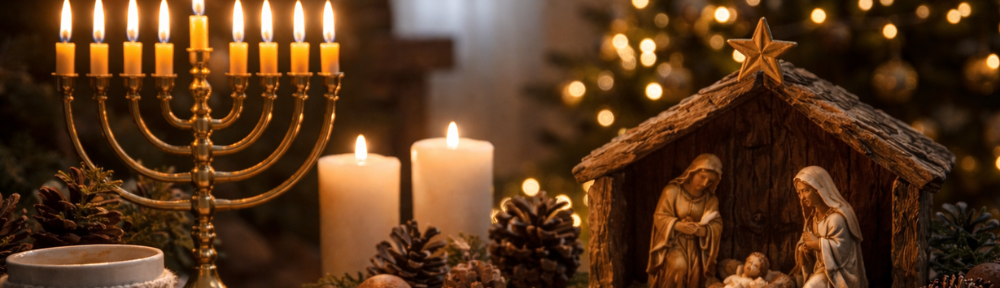
As I sit listening to George Frideric Handel’s Messiah on CBC Radio, I’m aware that I’m not the only Jewish listener using Christmas as a moment of reflection. This year, my thoughts have returned to the long history binding Jews, Christians, and Muslims, and to the strange way Christmas still lives inside the culture, even for those of us who don’t celebrate it religiously.
My meditation this year was sparked by several distinct but converging sources:
- A lecture by Helen Fry on the birth of Jesus as understood through historical sources
- An episode of Honestly with Bari Weiss, “The Birth of Christianity,” featuring Paula Fredriksen, one of the world’s leading scholars of early Christianity
- Lectures on Jesus and Muhammad by Tzvi Ben-Dor Benite through Lockdown University
- A lecture by David Peimar on “Christmas in the Popular Imagination” through Lockdown University
- CBC Radio Ideas: “Apocalypse for Christmas: Thomas Merton and the Inn”
None of this gave me neat answers. But it reopened questions I’ve been living with for decades: How did a Jewish messianic hope give rise to Christianity, and later Islam? How did these faiths develop within the same monotheistic inheritance? And why does Christmas still exert such power, even for those of us who stand outside it?
Living Between Two Worlds
I was born into a traditional Canadian Jewish Hungarian family in Montreal. I attended an English Protestant School Board day school, and I also went to the Talmud Torah on Fairmount Street four afternoons a week, plus Sundays. I grew up inside Jewish ritual time: Shabbat, Chanukah, the Torah readings, the cadence of synagogue life. But I was also immersed in the rhythms of Christmas and New Year’s, Quebec’s civic holidays, the music in stores, and the atmosphere in the streets.
I know the Christmas carols by heart. I know the Christmas movies too, and the seasonal rituals that mark the end of one year and the beginning of the next. For me, Christmas has always been both outside my life and somehow inside it too.
Islam entered my world differently. The first time I heard about it wasn’t through school or television, but from my Grade Two Hebrew teacher, a Polish Holocaust survivor. Some days, instead of teaching us the aleph-bet, he would drift into memory and tell us what he had lived through.
He once said that before WWII, Jews in Poland could not imagine Germany turning on them with such brutality. Many had thought of Germany as a culture of learning, sophistication, and structure. Some remembered German soldiers from World War I and could not reconcile that earlier image with what came next.
Then he said something that stayed with me:
“Ultimately, all three religions believe in One God. We are all alike in that sense!”
He said it with genuine perplexity. And in a way, it is obvious. Yet that shared belief has not prevented centuries of division, misunderstanding, and cruelty.
Jesus in His Own Jewish World
Helen Fry’s lecture situates Jesus firmly within the Jewish world of the late Second Temple period, where much historical scholarship now insists he belongs. Drawing on historical sources and comparative Gospel studies, she argues that Jesus was likely born not in Bethlehem, but in Nazareth, in the Galilee, his home region.
Most scholars agree that the historical Jesus lived roughly between 4 BCE and 30–36 CE, during a time when Jewish life was under immense pressure from Greek cultural influence and Roman power. Within a generation, Jewish sovereignty centered on the Temple in Jerusalem would collapse. The Temple, the spiritual and political center of Judea, was destroyed by the Roman military in 70 CE. After the Bar Kokhba revolt, in 135 CE, the Romans again crushed Jewish life, enslaving many, and renamed the province Syria Palaestina.
Jesus lived amid longing, tension, and messianic expectation, along with the political danger that always surrounded such hope.
And this context matters because it reminds us that Jesus was not an outsider to Judaism. He was a Jew living inside it.
Bethlehem, Messiah, and the Pull of Prophecy
One of the things that fascinates me is how stories form and why some versions endure.
In Jewish tradition, the Messiah (Mashiach) is not divine. He is a human king, a descendant of the House of David, destined to restore justice, bring Jews back to God and homeland, and usher in an era of peace.
King David was born in Bethlehem. So if you want to present Jesus as the Messiah in a Jewish framework, Bethlehem becomes symbolically unavoidable.
And yet the familiar Christmas details, “no room at the inn,” the shepherds, the Magi, do not appear in two of the four Gospels. Why do they appear in the others? Why did those images, of all things, become central to the story the world would repeat every December?
Revelation, Not Disaster
The word “Christ” is simply Greek for “Messiah.” And the word “apocalypse,” in Greek, means “revelation,” not catastrophe.
In the Jewish imagination, apocalypse is not about destruction for its own sake. It’s about the unveiling of truth, moments when what is hidden comes to light, when history is forced to answer for itself.
That is the world Jesus and Paul lived in.
So when early Christian writers connected Jesus to Bethlehem, the city of David, they were not inventing details at random. They were trying to connect him to prophecy and to Jewish expectations about what the Messiah would look like.
When the Story Split
As Paula Fredriksen explains, the earliest followers of Jesus did not believe they were founding a new religion. They believed they were living at the edge of the End of Days, inside the final chapter of Jewish history.
Paul (Saul of Tarsus), a Pharisaic Jew and citizen of the Roman Empire (c. 5–64/65 CE), did not see himself as leaving Judaism. He believed he was welcoming non-Jews into Jewish spiritual inheritance, while loosening some of the traditional requirements of Jewish belonging, such as circumcision and full adherence to the mitzvot.
In doing so, he helped set the foundation for what became the divergence between Judaism and Christianity. Over time, what began as an internal Jewish debate became a widening separation that eventually became something far more volatile.
This matters because anti-Judaism in Christianity didn’t come out of nowhere. It grew over time, as religion tangled with politics and power. And we still feel the effects. Many Christians don’t really know what Judaism teaches, and many Jews don’t really understand Christianity from the inside. In that space, misunderstandings multiply, and suspicion takes root on both sides.
Islam as a Continuation
Tzvi Ben-Dor Benite’s lectures changed how I think about Islam. Instead of feeling separate or foreign, it began to feel like another chapter in the same monotheistic story.
Benite describes Muhammad living among tribes in Mecca, many of whom worshipped their own gods. Muhammad preached the worship of one God and called people toward moral reform. He understood himself as standing within a prophetic tradition, calling human beings back to righteousness and accountability.
Some accepted his message; others rejected it. And from that early mix of refusal and belief, Islam took shape: its own scripture, its own vision, its own political world, yet still deeply connected to Jewish sources, language, and ideas.
And that brought me back to a question people often assume they already understand: what Jews mean when we say “Messiah.”
What Jews Mean by Messiah
I find that many people assume Jews and Christians mean the same thing when they say “Messiah.” We don’t.
In Jewish tradition, the Messiah (Mashiach) is not God, not half-God, and not someone who dies for the sins of the world. He is a fully human leader, someone who brings history back into balance.
He is meant to usher in an era of peace: no more war, oppression, or chaos. The world remains the world. Life continues. But it is repaired.
Within tradition, the Messiah is expected to be a descendant of the House of David. He will rebuild the Temple in Jerusalem and restore its role in the worship of the One God. He will gather Jewish exiles back to the Land of Israel. He will establish justice and Torah ethics at home and beyond, as people freely choose better moral lives.
Tikkun olam, repairing the world, isn’t a fantasy. It’s something to aim for.
I also came across a documentary trailer that lays out this traditional Jewish view clearly:
So What, Then, Is Christmas?
David Peimar raises a simple but unsettling question: is Christmas now mainly a global marketing event, or does it still offer something deeper?
He suggests that Christmas works like a pause, a moment when imagination breaks through the heaviness of daily life. Yuval Harari would probably say that makes sense, since he argues that human beings live by the stories we share.
Christmas may matter less for historical accuracy than for the story it tells, and the hope it keeps alive in dark times.
I don’t celebrate Christmas as a religious holiday. But I live inside its music, its imagery, and its longing. And each year, I find myself returning to the same question.
And I am not alone. This Christmas Eve, CBC Radio Ideas was thinking along similar lines, airing “Apocalypse for Christmas: Thomas Merton and the Inn,” a contemporary reflection on revelation, redemption, and transformation.
Thomas Merton helped reintroduce contemplative spirituality during a turbulent century. His Christmas story isn’t the one we usually hear. It’s less sweet and sentimental, and more searching, more honest about the inner work that spiritual life requires.
How did one Jewish life, rooted in Jewish hope, interpreted through Christian faith, and echoed within Islam, come to shape the spiritual imagination of billions?
Perhaps Christmas endures because it invites us, briefly, to remember something simple: beneath our divisions lies a shared human impulse to believe that goodness is real, that kindness matters, and that our world can still be redeemed.
Wishing you a Merry Christmas and a Happy New Year!
Selected Sources & References
- Paula Fredriksen, interviewed by Bari Weiss: “The Birth of Christianity”
- Helen Fry, lecture on the birth of Jesus (Lockdown University)
- David Peimar, “Christmas in the Popular Imagination” (Lockdown University)
- Tzvi Ben-Dor Benite, lectures on Jesus and Muhammad (Lockdown University)
- CBC Radio Ideas: “Apocalypse for Christmas: Thomas Merton and the Inn”
I highly recommend listening to Handel’s other oratorios, beyond Messiah. As beautiful as Messiah is, the others are equally beautiful, if not even more so. I myself, as a religious Jew, have a longstanding custom of listening to many of these oratorios, in the manner of listening to Messiah on Christmas, on such occasions as Passover (Israel in Egypt), Hanukkah (Judas Maccabaeus), and around the Shabbats of various haftarot – readings from the Prophets – that are related to this or that oratorio’s theme. An example of the latter sort is Samson for the haftarah of Naso, which falls out in late May to mid-June.
Thank you for sharing this; It appears that both you and Handel are more familiar with our biblical texts than many of the rest of us.
Hi Abigail,
Thank you for sending me your recent blogs. I find them well-written, informative, interesting and thought-provoking.
Reading your blog about meditation on Christmas brought me new thoughts similar to yours regarding Christmas celebrations.
Besides religious involvement, Christmas seems to me mainly a cultural and social celebration, a time of happiness, a time to focus on relationships, often centered on generosity, and an opportunity for expressing gratitude, acts of charity and helping others. The festivities focus on joy, togetherness and a festive atmosphere that brings excitement, music, parties and warmth during the winter season.
As you, I too feel the happiness, kindness, and relationship connections, allowing me the enjoyment of a meaningful Christmas season.