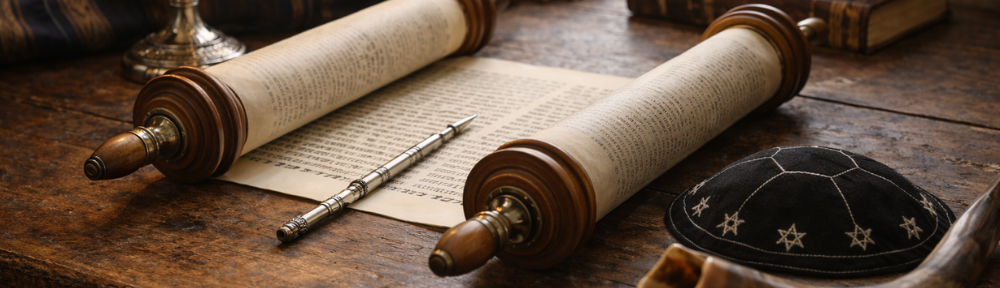
January, which coincides with the Hebrew month of Tevet, arrives with a particular weight. It carries fast days, civic memory, and an enduring call to live with conscience. In that spirit, I aim to explore how Jewish canonical texts, including the Torah, Talmud, and their commentaries, have shaped Jewish thought, politics, and the ways we remember across history and into the present.
Rabbi Lord Jonathan Sacks once noted that the Hebrew language lacks a word for “history.” Instead, it gives us zachor, remember. It is not a suggestion. It is a command – “Zachor!”
December 30, 2025 (10 Tevet, 5786): One Day, Many Layers
The Tenth of Tevet is known as one of the minor fasts. But what does “minor” actually mean? These are fasts and commemorations not recorded in the Torah itself, but instituted by the Sages and discussed in the Talmud.
- The 10th of Tevet commemorates the beginning of the Babylonian siege of Jerusalem during the period of the First Temple.
- The Fast of Esther, observed the day before Purim, recalls Esther’s request that the entire Jewish community undertake a three-day fast before she approached the King of Persia to annul Haman’s decree calling for the murder of all the Jews of Persia on the fourteenth day of Adar (Esther 4:16).
- The 17th of Tammuz marks the day the Romans breached the walls of Jerusalem.
- The Fast of Gedaliah, observed the day after Rosh Hashanah, commemorates the assassination of Gedaliah, the last Jewish sovereign of Judea after the destruction of the First Temple.
Each date carries its own story and its own moral weight.
January also contains civic and global milestones that point in the same direction, toward memory, accountability, and the unfinished work of justice.
In the United States, Martin Luther King Jr. Day is observed on the third Monday of January. On January 27, many nations mark International Holocaust Remembrance Day. These occasions offer time and space to reflect on our shared histories and the responsibilities they place upon us.
January is also when we begin reading the Book of Exodus in the weekly Sabbath synagogue service. Every year, it feels newly relevant, the story of an enslaved people freed from slavery in Egypt through God’s guidance and the courage of three siblings, Moses, Aaron, and Miriam.
The Book of Exodus as the Moral and Political Education of a Nation
The first four portions of Exodus are among the most dramatic chapters of Jewish narrative. The Israelites were originally welcomed into Egypt during the reign of a Pharaoh who knew Joseph, the brother whose wisdom had saved Egypt, and much of the civilized world, from seven devastating years of famine. But that welcome did not last. As the text famously tells us, “A new king arose over Egypt, who did not know Joseph” (Exodus 1:8).
Oppression builds gradually, tightening year by year, over the course of 210 years, until it culminates in something horrific, an order to kill all Hebrew baby boys at the moment of birth.
We follow the story through generations of enslavement, the birth of Moses, the Jewish baby boy condemned to die yet raised in Pharaoh’s court by Pharaoh’s daughter, witnessing injustice and intervening, but failing to make a mark, his flight from Egypt to the deserrt, his marriage to Tzipporah, daughter of a Midianite priest, and finally his encounter with God at the burning bush: Called there in middle age, Moses is sent back to Egypt to confront Pharaoh and lead his people out of slavery. What follows, the plagues, the confrontation, the exodus itself, has become part of humanity’s moral vocabulary.
Rabbi Lord Jonathan Sacks explores this story in Covenant and Conversation: A Weekly Reading of the Jewish Bible: Essays on Ethics¹. His reading speaks directly to the world we are living in now.
Shemot: The Quiet Courage of Civil Disobedience
In the opening chapter, Shemot, Rabbi Sacks draws our attention to a moment that is often overlooked, the story of Shifra and Puah, the midwives ordered by Pharaoh to kill all male Jewish infants at birth.
They do not comply.
“The king of Egypt spoke to the midwives, one of whom was named Shiphrah and the other Puah, saying, ‘When you deliver the Hebrew women, look at the birthstool. If it is a boy, kill him; if it is a girl, let her live.’
But the midwives feared God and did not do as the king of Egypt had told them; they let the boys live.
So the king of Egypt summoned the midwives and said to them, ‘Why have you done this thing, letting the boys live?’” (Exodus 1:15–18)
What makes their refusal extraordinary is how quiet it is. There is no speech, no rebellion, no spectacle. Just a simple decision to do what is right in the face of absolute power.
“The Midwives Feared God”
The Torah has no word for religion. The closest concept it offers is Yirat Hashem, the fear of God.
Shifra and Puah understood that God’s moral demands outweigh Pharaoh’s legal authority. Rabbi Sacks notes that their defiance may well be the first recorded act of civil disobedience in history.
A few verses later, the pattern reverses: Pharaoh commands the Egyptian population to throw all Jewish baby boys into the Nile. This time, the people comply. They fear Pharaoh more than they fear God, and they become participants in genocide.
Joseph Telushkin draws a parallel between Shifra and Puah and those who rescued Jews during the Holocaust. The rescuers were answering to a higher moral authority. The many collaborators may have feared Nazi power more than they feared moral judgment.
This principle, that obeying immoral orders does not absolve responsibility, was only formalized in Western law after World War II, when the “crimes against humanity” statute was first enacted as part of the Nuremberg trials. “I was only following orders”, the defence of so many of the officers on trial could no longer be accepted. Some commands are so wrong that obedience itself becomes a crime.
Memory Isn’t Passive: It Demands Something From Us
It would be easy to treat the story of Exodus as ancient history. But the Torah insists that leaving Egypt is only the beginning. Freedom is not the end of the journey. The harder task is what comes after, the slow and demanding work of building a just society.
That same lesson appears again in modern history. Martin Luther King Jr. made the same point: injustice written into law does not excuse obedience, and obeying unjust laws is not harmless.
For Jews, remembering the Holocaust is never only about the past. It is also about telling the truth in the present, especially when people attempt to blur it, reshape it, or deny it altogether.
This year, the Jewish community invited Elisha Wiesel, the son of Elie Wiesel, to preview Soul on Fire, the recent film about his father. In an interview with Susan Schwartz in the Montreal Gazette, Elisha reflected on his father’s legacy and its relevance today.²
In his 1986 Nobel Peace Prize acceptance speech, Elie Wiesel said:
“I have tried to fight those who would forget, because if we forget, we are accomplices. We must always take sides! Neutrality helps the oppressor, never the victim.”
This last sentence lands with particular force: “Neutrality helps the oppressor, never the victim.”
Elisha Wiesel was asked by a reporter:
“What does he think his father would have said about the rise in antisemitism around the world and the drumbeat of Holocaust deniers?”
He replied:
“My father clearly articulated that the antisemites will always hate, even if they mask that hate as anti-Zionism, as though it were somehow separable from antisemitism.
My father never failed to stand up for Israel, asserting that only Israelis can best decide how to reach their goals of living in peace in an extremely hostile neighbourhood. And lastly, he insisted that we never relinquish our desire to have a positive impact on the world as a whole. He strongly resisted isolationism as a principle.”
Holocaust denial continues to plague us. And the more chaotic the world becomes, the more tempting it is for some to adjust history until it becomes unrecognizable, or to bury their heads in the sand.
Seen from this perspective, the biblical story stops being ancient history. It becomes one of the foundations of how we understand justice today.
It also reminds us of something we forget too easily. Freedom and democracy are not sustained by laws and elections alone. Their lifeblood depends on individuals who refuse to leave their conscience at the door.
This is not a dramatic or cinematic lesson. It is a daily one. Most moral decisions are not made in grand moments. They are made in small choices, often in silence, when no one is watching, and no one is applauding.
What do you do when the state commands you to do the wrong thing?
How does any society lose, or recover, its moral freedom?
Why do some people cling to tyranny even as it destroys them?
What sustains a people across centuries of pressure?
These are some of the questions Rabbi Sacks returns to in his subsequent essays.
The Question January Leaves Us With
These fast days and memorial days matter not because they keep us rooted in grief, but because they force us to confront what human beings are capable of, and to ask whether we are paying attention.
As I write this, the news makes it impossible to look away. We are witnessing, in real time, the Iranian people attempting to free themselves from the ruthless Islamist regime of the Ayatollahs. In a recent segment of CBC’s The Current, titled “The Push for Justice in Iran,” Matt Galloway interviewed Payam Akhavan about the ongoing human rights catastrophe in Iran and the brutal slaughter of protestors.
The Iranian people are crying out to the world. Who will hear them?
And so January becomes one of those rare months where everything converges.
The Fast of the Tenth of Tevet.
MLK Day.
International Holocaust Remembrance Day
and contemporary realities – all pointing toward the same question.
What will you do with what you know?
Thank you for sharing this moment with me.
I welcome your feedback. If you would prefer to share your thoughts privately, you are welcome to email me at askabigail@me.com.
Footnotes:
- Sacks, Jonathan. Covenant & Conversation: A Weekly Reading of the Jewish Bible: Essays on Ethics. “Parashat Shemot.”
- a. Schwartz, Susan. “Son of One of the World’s Most Public Holocaust Survivors Upholds Father’s Legacy.” Montreal Gazette, 21 Jan. 2026. b) YouTube A conversation with Elisha Weisel, Montreal Holocaust Museum, Jan 26, 2026