On Monday night, I attended a lecture in Montreal marking the first anniversary of the death (the yahrzeit) of Yosef Lefkovic, a Holocaust survivor who raised his family here and was deeply known to many in our community, including my late father.
Yosef accompanied our recent community journey to Poland, visiting Jewish heritage sites and places of Nazi massacres. Already in his nineties, he shared his story with clarity, humility, and strength over several days. He was also the author of The Survivor: How I Survived Six Concentration Camps and Became a Nazi Hunter. His presence, and now his absence, reminds us that the era of living Holocaust testimony is rapidly closing, even as its lessons remain painfully urgent.
Over the past year, I have watched several documentary films about the events of October 7, each offering eyewitness accounts of unspeakable brutality alongside extraordinary acts of courage and rescue. During this Chanukkah season, I would like to share one of these films, a special offering from the Holocaust Institute at the University of Miami.
🎬 Milk & Honey, Blood & Tears — an online documentary available to view December 14–24.
Filmed over 18 months beginning in November 2023, Milk & Honey, Blood & Tears follows survivors of Kibbutz Be’eri, documenting their grief, resilience, and gradual return to life after October 7. Created by journalist and filmmaker Leslie Benitah Gelrubin, a third-generation Holocaust survivor, it draws a direct line between Holocaust testimony and contemporary survival, a continuation, not a departure, from the story of Jewish endurance.
🕯️ View the film: www.dropbox.com
Alongside these films, I have also turned to firsthand written testimony. I have just finished reading Hostage by Eli Sharabi, who was kidnapped from Kibbutz Be’eri on October 7 and held in underground tunnels with three others for 471 days before his release. Page by page, Sharabi recounts survival through hunger, humiliation, and violence, sustained by will, ingenuity, and inner resolve. In just 178 pages, you experience his captivity minute by minute. First published in Hebrew, the book has since been translated into many languages, including English and French. It is a remarkable and unsettling read.
This Chanukkah, we are again confronted with tragic news, this time from Bondi Beach, Australia, where Jews were attacked during a public Chanukkah candle-lighting ceremony. Reports describe heroic attempts by bystanders to protect others in a country with strict gun laws and only two police officers on duty at the time.
According to The Montreal Gazette (Wednesday, December 17, 2025), video footage shows Sofia Gurman (61) and her husband, Boris Gurman (69), confronting one of the attackers. Boris wrestled a weapon away, striking the gunman before being fatally shot by a second weapon. Sofia was also killed. Their actions were acts of instinctive courage, ordinary people responding to sudden evil.
These events remind us that the lessons of the Maccabees are not relics of the past but remain relevant in our own time, rooted in the band of brothers who rose in 167 BCE to preserve Jewish cultural heritage in the face of Hellenistic domination.
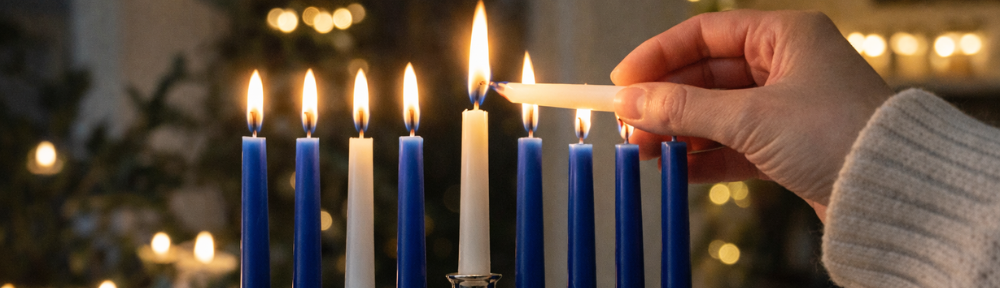
As I light my Chanukkah candles this year, in my home and also in the lobby of my apartment building, I am keenly aware of winter, uncertainty, and danger surrounding us across the globe. The flames are small and fragile, yet they persist. They remind us both of the vulnerability of life and of the enduring truth that the few can stand against the many.
I am also reminded of a Chanukkah song I learned in second grade, marching around the classroom:
Mi yemalel gevurot Yisrael?
Who will tell the stories of Israel’s heroes?
In every generation, when people unite,
A hero will surely arise to redeem the nation.
🎵 Sung here by a multi‑ethnic class of children at PS 22:
www.youtube.com
This week, I also came across a reflection by Rabbi Benlolo, which deeply resonated with me and inspired much of this message:
On the first night of Chanukkah, as we lit a single, defiant flame, the world was again shaken by violence. And yet, on that very day, a quiet act of kindness unfolded, a bouquet left anonymously at a synagogue door with a handwritten note: We see you. We stand with you. You are not alone.
Chanukkah does not deny darkness. It exists because of it. But it insists that light still matters, that goodness appears precisely when it is most needed, often without recognition or applause.
As we continue lighting our candles night by night, may the memories of those lost be a blessing. May we recognize courage when it appears quietly. And may we each strive, in small but meaningful ways, to be the light someone else needs.