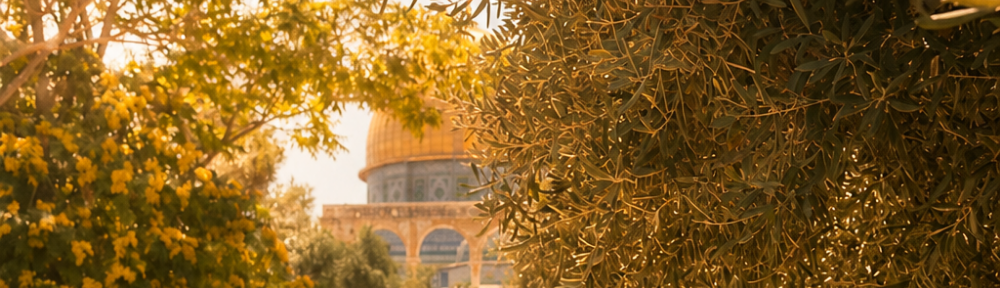
During the Three Weeks leading to Tisha B’Av this year, I found myself thinking not only about destruction and loss, but also about the Jewish idea of chazon, meaning vision.
Tisha B’Av commemorates the destruction of both Temples in Jerusalem. Over time, it has also become a day when we remember other tragedies that have befallen the Jewish people.
The list is painfully long.
We remember the persecution of Jews under the Almohads in North Africa and Spain, the expulsion from Spain in 1492, the Inquisition, the Khmelnytsky massacres in Ukraine and, of course, the Holocaust.
And now, October 7 has entered our collective memory.
Arriving at Tisha B’Av This Year Felt Different
Nearly three years have passed since October 7, but its effects are still very much with us.
As I write, war continues across the region. The conflict involving Iran remains unresolved, shipping through the Strait of Hormuz has been disrupted, and Israeli soldiers are still serving in Gaza and along the Lebanese border.
I think of the soldiers and their families, and also of the civilians throughout the region whose lives continue to be disrupted by war.
Yet in the middle of all this, one word keeps coming back to me: chazon.
The Shabbat before Tisha B’Av is called Shabbat Chazon, after Isaiah’s vision that is read in the Haftarah.
There is also a beautiful Hasidic teaching associated with Rabbi Levi Yitzchak of Berditchev. He taught that on Shabbat Chazon, every Jewish soul is shown a distant vision of the future Temple, even if we are not consciously aware of it.
I find that idea very moving.
Even in our deepest mourning, we are still encouraged to think about what can be rebuilt.
Home at Last
This year also brought something for which we had all, individually and collectively, prayed for so long.
On January 26, 2026, the remains of Ran Gvili, the final hostage still held in Gaza, were recovered and returned to Israel for burial.
By then, every hostage taken on October 7 had finally been brought home. Those who survived returned to begin the difficult process of rebuilding their lives. Those who were killed could finally be laid to rest.
It was an answer to our prayers, although certainly not the ending we had hoped for.
Many of the returned hostages have begun sharing their experiences through interviews, books and filmed testimonies. Families and communities are also creating memorials for those who did not survive.
These stories are now becoming part of our collective memory.
Find Me, Okay?
A few days ago, at the Jerusalem Film Festival, I watched one of the films preserving that memory: Find Me, Okay?, directed by Yula Gidron.
On the morning of October 7, Eden Yerushalmi and her best friend, Arbel, were dancing at the Nova Festival. Hours later, Eden was taken to Gaza while her sisters listened helplessly on the telephone.
The film follows Eden’s mother, sisters and best friend through two years of uncertainty, public struggle and unbearable loss.
It begins with the hope that Eden will come home. It then shows what happens when that hope collapses, and a family must somehow learn to continue living.
The film is deeply personal, but Eden’s family also represents so many Israeli families whose lives were divided forever into a “before” and an “after.”
I left the theatre thinking that Jewish memory does not exist only in history books. We are watching it being created before our eyes, while the wounds are still raw.
Trailer: https://jff.org.il/en/movie/94974
A Different Kind of Hope
In addition to following the news, I belong to several groups that try to keep our spirits up during these difficult times. Among them are Yanky Fachler’s Morale Boosting Doodles and a WhatsApp group called Segula Snippets.
A recent Segula Snippets post revisited the story of Naomi Shemer’s beloved song, Jerusalem of Gold.
Shemer wrote the song shortly before the Six-Day War in 1967, when Jerusalem was still divided, and Jews had no access to their holiest site, the Western Wall. The Wall, along with the entire Old City of Jerusalem, was then under Jordanian control.
Drawing on the language of Lamentations and centuries of Jewish poetry, she wrote a modern lament for Jerusalem. The song expressed both the loneliness of the city and the longing of a people who had never forgotten it.
“Jerusalem of gold, and of bronze, and of light.”
When the song was first performed in May 1967, the audience immediately connected with it.
In a letter to her daughter, Shemer’s mother compared the song to a tank entering the divided capital. It was not a tank in the usual sense, but it carried with it generations of Jewish longing.
Only a few weeks later, during the Six-Day War, Israel captured the Old City and East Jerusalem from Jordan. Jews were once again able to reach the Western Wall, and Shemer added a new verse celebrating the return to the city’s streets, markets and holy places.
The lament had become a song of return.
The Segula Snippets WhatsApp group revisits stories and events from Jewish history:https://bit.ly/Segula-Snippets
Looking Beyond the Ruins
Perhaps that is why the story of Jerusalem of Gold speaks to me so powerfully this year.
Tisha B’Av asks us to remember what was destroyed. It asks us to mourn the people, communities and sacred places that were lost.
But it does not ask us to remain forever among the ruins.
Shabbat Chazon gives us a vision before the fast even begins.
For many Jews, including me, the hope for the rebuilding of the Temple continues to represent spiritual renewal, return and redemption. It is a hope rooted in Jewish tradition and carried through centuries of exile.
I also recognize that the Temple Mount, known to Muslims as Al-Haram al-Sharif, is sacred to both Jews and Muslims and remains one of the most sensitive places in the world. Speaking honestly about Jewish longing does not require us to deny the deep attachment of others to Jerusalem.
Still, we should not be afraid to speak about our own memories and hopes.
Jewish history has taught us to carry mourning and hope together.
We remember what was destroyed. We honour those we lost. We listen to those who survived.
And then, somehow, we continue to build.