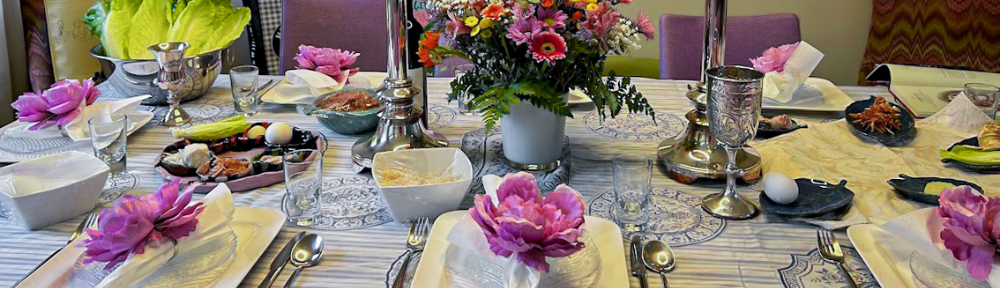
Every year at Passover, Jewish families gather around the seder table to tell an ancient story: the story of slavery, freedom, loss, hope, and the long road out of Egypt.
But at many seder tables, another story is told, too.
The family story.
The story of who survived, who escaped, who rebuilt, and how the people sitting around the table came to be there at all.
That has always felt like the deeper power of Passover to me.
Even Jews who may not feel especially connected to religious life the rest of the year often still come for the seder. They come for the table itself, the familiar foods, the songs, the questions, the back-and-forth, the laughter. They come because Passover is not only about recalling a distant past. It is also about handing something on.
The Haggadah keeps returning to that idea: tell the story to your child. Not just remember it quietly. Not just read it. Tell it. Out loud. Across the table. From one generation to the next.
Maybe that is one reason the seder has lasted so long. It is not only a ritual. It is a way of keeping memory alive.
In My Family, Passover Was Never Only About Egypt
Like every Jewish family, ours had its own way of moving through the seder. Some parts were serious, some funny, and some lovingly repetitive. The ancient story was always there, of course, but so were our own family stories.
In my family, Passover was also the time when we told, again and again, how we survived the Holocaust, escaped Communist Hungary, and eventually built a new life in Canada.
As a child, I did not think of these as separate stories. To me, they belonged together: the story of a people leaving slavery, and the story of one family finding its way to freedom.
That was simply what Passover was.
The First Family Miracle
The first miracle always celebrated at our family’s seder table was my birthday.
I was born on April 16, 1946, during Passover, in Debrecen, Hungary, less than a year after the war. I was one of the first babies born in my family after the devastation of the Shoah.
The place where I was born carried its own sorrow. My grandfather Shlomo Yisroel Hirsch’s compound at 12 Simonffy Street had been looted after members of the family were deported to Auschwitz in the spring of 1944 and never returned. My grandfather, his second wife, and four daughters were among those lost.
And yet by Passover 1946, surviving members of the family had gathered there again.
The men were in synagogue when word came to my father that I had been born at home, with the help of a midwife. Two sofas were pushed together to make my crib.
And everyone came to stare.
A baby.
I have always loved that image. After so much loss, there was suddenly a baby in the house. Not an idea about hope. Not a speech about survival. Just a baby. Small, fragile, and alive. In its own quiet way, it meant life was beginning again.
The Second Family Miracle
The second story always told at our seder was our escape from Communist Hungary in 1949.
It happened on a night that fell during both Passover and Easter. They guessed the borders might be more loosely guarded.
That evening, my mother was in Tokaj with her brother Jeno for the holiday. The table had already been set for the holiday meal. Then, later that night, she slipped away, carrying my sleeping one-year-old sister Anita in her arms. I was three years old and already walking. With us were my mother’s brother Tibor, known as Teddy, and a hired guide.
We crossed fields and forests through the dark, walking all night until we reached the Czech border and then our first place of shelter: a barn.
My father was already in Vienna, waiting for us.
Within a week, we were reunited and managed to get to Vienna, where we reached the Rothschild Hospital, which had been turned into a hostel for Jewish refugees by the Joint Distribution Committee.
That story became part of Passover in our family, too. Not because it replaced the Exodus, but because it felt so much like it. Danger. Flight. Night. Uncertainty. The hope of safety. The possibility of beginning again.
What Happens Around a Seder Table
That, I think, is why the seder still speaks to so many people.
It is not only that Jews remember. We do. But Passover gives memory a place at the table. It turns memory into conversation.
At a good seder, the story in the Haggadah and the family story sit side by side. Someone reads from the Haggadah. Someone interrupts with a memory. A child asks a question. An older relative corrects a detail. Somebody laughs. Somebody gets emotional. The meal takes forever. And somehow that is exactly the point.
What is being passed down is not only information. It is belonging.
A Moment I Still Remember
One of my favourite Passover memories comes from one of the last times our extended family was all together around the seder table in Montreal.
My dear mother, Esther, Etelka, Edith Zoldan Hirsch, of blessed memory, looked around the table at her children, their spouses, and their children, and said, with a glint in her eye, “If not for me, none of you would be here!”
It was funny, proud, loving, and entirely true.
We laughed, of course. But underneath the laughter was the deeper truth she had earned the right to say. Around that table sat children and grandchildren because people had survived, escaped, rebuilt, and chosen life.
That is part of Passover too.
Why I Still Come Back to This Night
For me, Passover has never been only about ritual. It is about continuity. It is where the larger Jewish story meets the smaller family story, and both become real again.
At our seder table, we did not only speak about leaving Egypt. We spoke about survival after the Holocaust, escape from oppression, and building a new life in freedom. Those stories shaped me. They taught me that history was not something locked away in a book. It lived in the voices around the table.
That is why, year after year, we return to the Passover table, not only to remember, but to tell the story again and keep something essential alive.
Further reading:
I have written many other posts on Passover here: https://www.askabigailproductions.com/?s=Passover&submit=Search
Note: Part of this reflection draws on my earlier post, The Passover Seder: A Living Legacy of Redemption, posted 09/04/2025: https://www.askabigailproductions.com/the-passover-seder-a-living-legacy-of-redemption/